Welcome to shopicat Mall!
Welcome to shopicat Mall!
購物車
Close您的購物車還沒有商品!!
If you use or are considering buying a Rabbit Vibrator, you definitely want to know how long it will last – both during a satisfying session and between charges. Battery life and charging time directly impact usability and the continuity of your pleasure. Nobody wants their device to die at the worst possible moment, or to wait half a day to use it again. In this article, we’ll break down the typical runtimes, charging times, and the key factors that affect performance, giving you the practical information you need to make a smart purchase decision.
On average, a mid‑range Rabbit Vibrator delivers 1 to 2 hours of runtime on a full charge, with a charging time of 1.5 to 3 hours.
Runtime is mainly affected by motor type, vibration intensity level, and battery capacity.
High‑end models (with brushless motors and lithium‑ion batteries) can provide 2+ hours of continuous use and charge faster.
The best ways to extend battery life are to avoid full discharges, use the correct charger, and store the toy properly.
Generally, most Rabbit Vibrators on the market offer 1 to 2 hours of continuous use on a full charge. This is plenty for the vast majority of solo or partner sessions. However, this number varies significantly depending on the product’s specific design. Some long‑runtime models can reach 3 hours or more, while cheap units with a powerful motor but tiny battery may start fading after just 30 minutes.
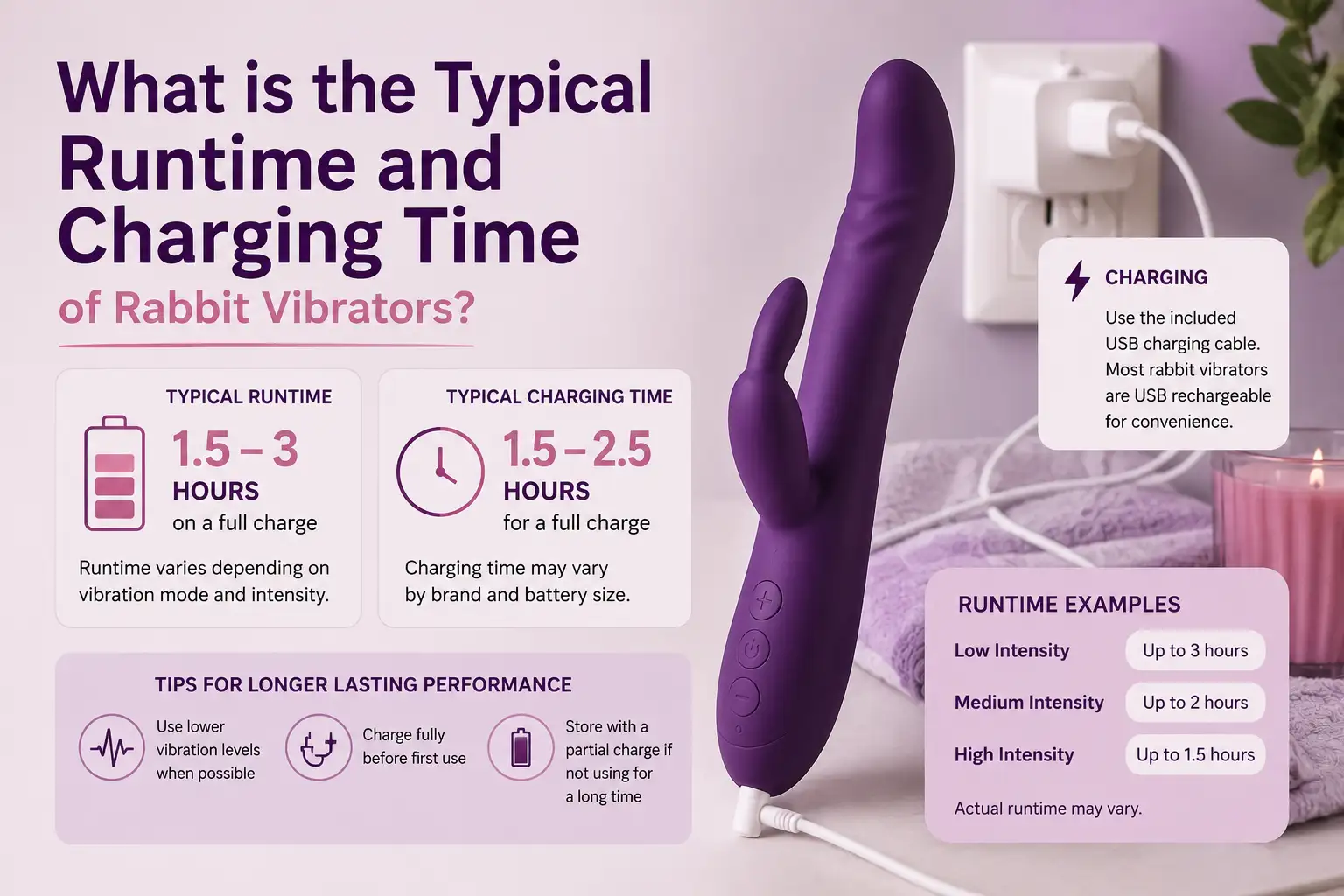
It’s important to note that “runtime” also depends on how you define “use.” If you always keep the vibration on the highest setting, the battery drains much faster. If you prefer lower intensities or intermittent patterns, runtime can extend considerably. Also, models with heating, thrusting, or rotating functions consume extra power, which reduces overall runtime.
Different types of Rabbit Vibrators have very different runtimes. Below are typical runtime estimates under constant medium vibration (actual results may vary):
| Type / Features | Typical Runtime (continuous) | Notes |
|---|---|---|
| Mini/compact (single motor) | 45 min – 1.5 hr | Smaller battery capacity |
| Standard (dual motor) | 1 – 2 hr | Medium battery, both motors running |
| High‑end (brushless motor + large battery) | 2 – 3 hr | Higher efficiency, larger battery |
| With heating / thrusting | 45 min – 1.5 hr | Extra features consume more power |
| Cheap / unknown brand | 20 min – 1 hr | Overstated battery specs, rapid degradation |
Most modern Rabbit Vibrators take between 1.5 and 3 hours to fully charge. This is enough time to go from completely dead to 100%. Charging speed depends mainly on battery capacity (measured in mAh), the type of charging port (USB‑A, USB‑C, or magnetic), and whether the device supports fast‑charging protocols.
Entry‑level products with standard Micro‑USB ports usually charge more slowly, often taking 2.5 to 4 hours. Mid‑range and high‑end models with USB‑C and fast‑charge support can cut that down to 1 to 2 hours. Magnetic charging ports are becoming increasingly popular on premium toys because they are easier to connect and offer better waterproofing, with speeds comparable to USB‑C.
Keep in mind that the first time you use your toy, it’s a good idea to follow the manufacturer’s initial charging instructions (typically fully charge plus an extra 1‑2 hours of trickle charge). This helps calibrate the battery management system and extends overall battery life.
The battery is the heart of runtime. Most mainstream Rabbit Vibrators now use lithium‑ion batteries. Quality lithium‑ion batteries offer high energy density, no memory effect, and low self‑discharge.
Capacity (mAh) : Larger capacity generally means longer runtime. Standard toys have battery capacities between 400mAh and 1200mAh. Premium models can go above 1500mAh.
Quality : Reputable brands use Grade‑A cells that retain >80% of their capacity after 300‑500 charge cycles. Cheap products use low‑grade cells that degrade noticeably after just a few months.
You should be aware that a larger‑capacity battery usually needs more time to charge, but fast‑charging support can offset that downside.
The motor is the most power‑hungry component in a Rabbit Vibrator.
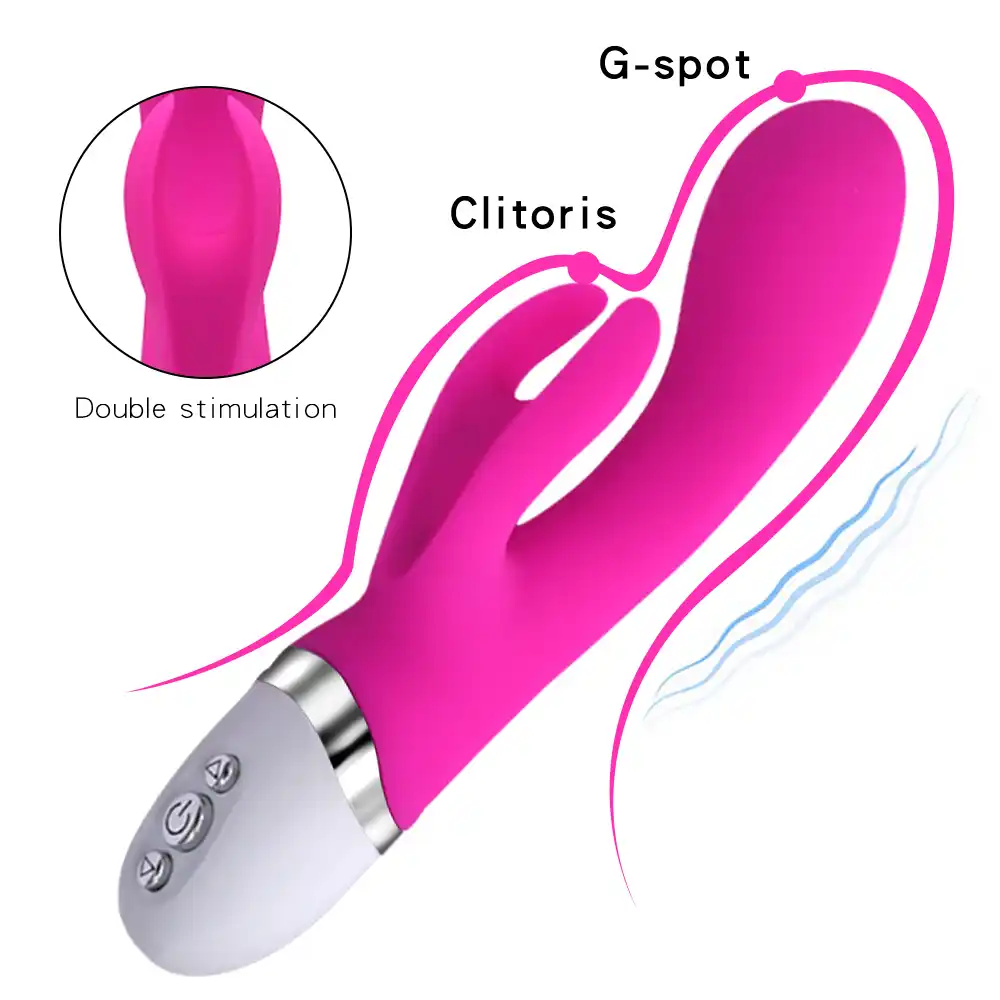
Dual motor vs. single motor : A standard Rabbit Vibrator has two separate motors (shaft and ears). Running both at the same time consumes significantly more power than a single‑motor mini toy. High‑end dual‑motor designs use more efficient circuitry and brushless motors to deliver strong vibrations while maintaining reasonable runtime.
Pancake (eccentric) motors vs. rotary motors : Pancake motors are cheap to produce but have lower energy efficiency and generate more heat. Brushless rotary motors are far more efficient, providing longer runtime for the same battery capacity.
Your usage habits have a huge impact on how long the battery lasts.
Highest intensity : Running the toy at maximum vibration can drain the battery in 45 minutes to 1 hour.
Low/medium intensity or intermittent patterns : The same toy may run for 2 hours or more.
Smart modes : Some premium products offer “eco mode” or automatic dimming (similar to dimming schedules on street lights) that save power without noticeably affecting pleasure.
Heating, thrusting, and rotating functions consume extra power. If runtime is your top priority, consider a basic model or only turn on those features when you really want them. Some vibrators let you turn off the shaft or ear motor independently, using just one at a time – this also extends runtime.
While a Rabbit Vibrator doesn’t have a monthly electricity bill (its energy use is tiny – a full charge consumes roughly 0.005‑0.01 kWh, costing essentially nothing), you can think in terms of lifecycle cost: purchase price ÷ (runtime per charge × number of charge cycles).
But what does “number of charge cycles” actually mean? A quality lithium‑ion battery in a well‑made toy typically lasts 300 to 500 full charge cycles before its capacity drops below 80% of the original. Cheap, low‑grade cells may fail after only 50 cycles.
Avoid full discharges : Don’t wait until the toy is completely dead before charging. Lithium‑ion batteries last longest when kept between 20% and 80% charge.
Use the supplied or a compatible charger : Use a charger with matching voltage and current. Too high a voltage can damage the battery, while too low will charge extremely slowly.
Unplug when fully charged : Although modern batteries have over‑charge protection, keeping them at 100% for long periods also accelerates aging.
Store properly : Don’t leave your toy in hot places (e.g., a car in summer) or damp environments. Ideal storage is at 15°C‑25°C (59°F‑77°F) with about 50% charge.
Use it regularly : If you won’t use it for months, charge/discharge it every 3‑6 months to keep the battery from going into deep sleep.
Keep the charging port dry : Make sure the charging port is completely dry before plugging in to avoid short circuits.
Most mid‑range and high‑end products have an LED indicator: it may flash or change color when the battery is low; during charging it may stay on or breathe; when fully charged it turns solid or goes off. Some Bluetooth‑enabled models show the exact remaining battery percentage in a smartphone app.
Not usually. Unless you always use the highest intensity with every extra feature turned on (heating + thrusting + both motors at max) and it’s a compact model, 20 minutes is very short. It could indicate battery aging (after 2+ years) or a manufacturing defect. If you’re still under warranty, request a replacement.
Technically yes, but it’s strongly discouraged. Using while charging generates extra heat, accelerates battery aging, and poses a potential safety risk (especially on cheap toys). Plus, the cable restricts movement and can ruin the experience. Get in the habit of charging after each use.
If the port is the same (e.g., USB‑C) and the output voltage/current are standard (standard USB outputs 5V, 1A‑2A), it’s usually fine. However, avoid using fast phone chargers that output 9V/12V unless the toy explicitly says it supports them. Higher voltage can damage the internal circuitry.
When a full charge gives you less than 50% of the original runtime and the charging time becomes noticeably shorter (e.g., goes from 2 hours to 30 minutes), the battery has severely degraded. If the battery is not user‑replaceable, that usually means the toy has reached the end of its life – it’s time for a new one.
Your ultimate pleasure depends on motor quality, body‑safe materials, and battery performance – but choosing a toy with runtime that fits your habits is essential.
If you usually have short sessions (15‑30 minutes) or mostly use the toy for foreplay rather than extended stimulation, 1 hour of runtime is plenty.
If you enjoy longer solo or partner sessions (45+ minutes) or simply hate frequent charging, look for models with 2+ hours of runtime and pay attention to battery capacity (1000mAh or more).
If you travel often or tend to forget to charge, choose a model with fast charging (USB‑C or magnetic fast charge) and low self‑discharge – it will be much more convenient.
We recommend a minimum spec of: a high‑quality lithium‑ion battery (at least 800mAh), dual motors with independent control, support for USB‑C or magnetic fast charging, and at least 1.5 hours of runtime at medium intensity. This will give you a smooth, uninterrupted pleasure experience in almost every scenario.

 繁体中文
繁体中文 English
 简体中文
简体中文